
Compare PVC-free blackout, screen and light-filtering constructions, then request the documentation and samples required for your specification.
Choose by application
- Office screen: compare 3% and 5% openness options.
- Blackout: confirm light-control and fire-test requirements.
- Green-building project: request the relevant certification scope.
Why Sustainability Matters in Window Treatments
The commercial design industry is undergoing a fundamental shift toward sustainable materials. According to the World Green Building Council, green building projects now account for over 40% of new commercial construction worldwide. For architects, interior designers, and procurement managers specifying window treatments, the demand for PVC-free and recycled roller blind fabrics has moved from niche preference to mainstream requirement.
This guide provides a comprehensive overview of sustainable roller blind fabric options — including PVC-free formulations and rPET (recycled polyethylene terephthalate) materials — covering environmental benefits, performance characteristics, relevant certifications, and how these fabrics contribute to green building rating systems like LEED and WELL.
The Environmental Problem with Conventional PVC Fabrics
Polyvinyl chloride (PVC) has been the dominant material in roller blind fabrics for decades due to its durability, flame resistance, and low cost. However, its environmental impact has become impossible to ignore:
Manufacturing impact: PVC production requires chlorine gas and vinyl chloride monomer (VCM), both classified as hazardous substances. The manufacturing process releases dioxins — persistent organic pollutants that accumulate in the food chain and are linked to cancer and reproductive disorders.
End-of-life concerns: PVC is virtually non-biodegradable and extremely difficult to recycle due to its complex additive package (plasticizers, stabilizers, flame retardants). Most PVC blinds end up in landfills where they can persist for centuries, leaching phthalates and heavy metals into soil and groundwater.
Indoor air quality: PVC blinds can off-gas volatile organic compounds (VOCs), particularly when exposed to direct sunlight and elevated temperatures. Studies have detected phthalate esters and organotin compounds in indoor air near PVC window treatments, raising concerns in hospitality and healthcare environments where occupant health is paramount.
Understanding PVC-Free Roller Blind Fabrics
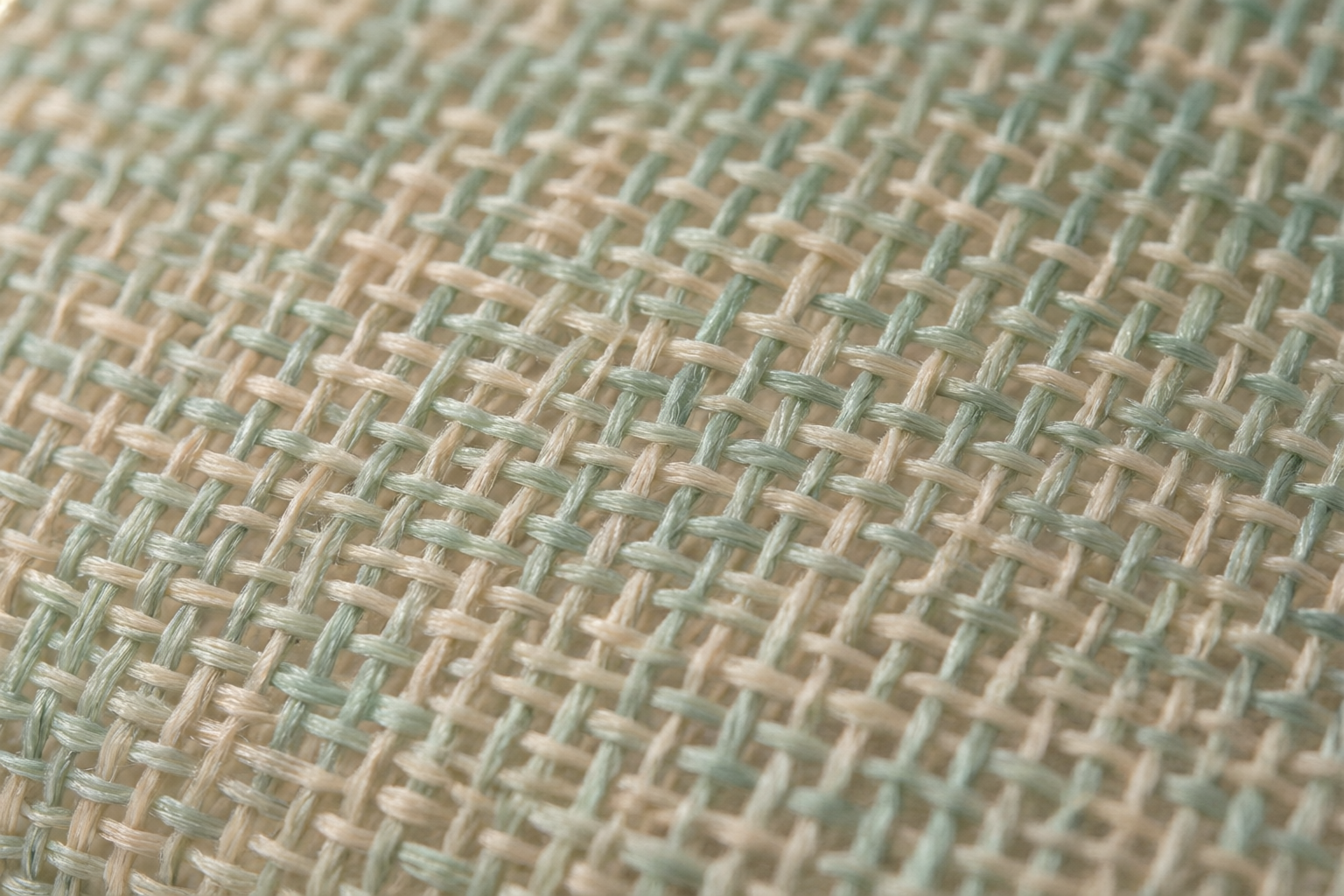
PVC-free roller blind fabrics eliminate polyvinyl chloride entirely, replacing it with alternative polymer systems that deliver comparable performance without the environmental and health drawbacks. Common PVC-free formulations include:
Polyester-based fabrics: High-tenacity polyester yarns woven on precision looms, then finished with acrylic or polyolefin-based coatings. These fabrics achieve excellent dimensional stability, color fastness, and flame resistance without chlorine-based chemistry. PVC-free polyester fabrics typically weigh 280–420 g/m² and are available in both blackout and dim-out constructions.
Olefin-based fabrics: Polypropylene and polyethylene blends offer inherent moisture resistance and can be produced without halogenated flame retardants. While less common in premium roller blinds, olefin fabrics are gaining traction in budget-conscious hospitality projects.
Key advantages of PVC-free fabrics:
- Zero dioxin emissions during production and disposal
- No phthalate plasticizers — safer for occupants and installers
- Lower VOC emissions, contributing to healthier indoor environments
- Fully recyclable at end of life through standard polyester recycling streams
- Compatible with LEED, WELL, BREEAM, and other green building rating systems
AWT Textile’s PF PVC-Free Eco series represents the latest generation of PVC-free roller blind fabrics, offering 100% PVC-free construction with performance parity to traditional PVC alternatives across blackout, dim-out, and light-filtering options.
rPET Recycled Fabrics: Turning Waste into Window Coverings
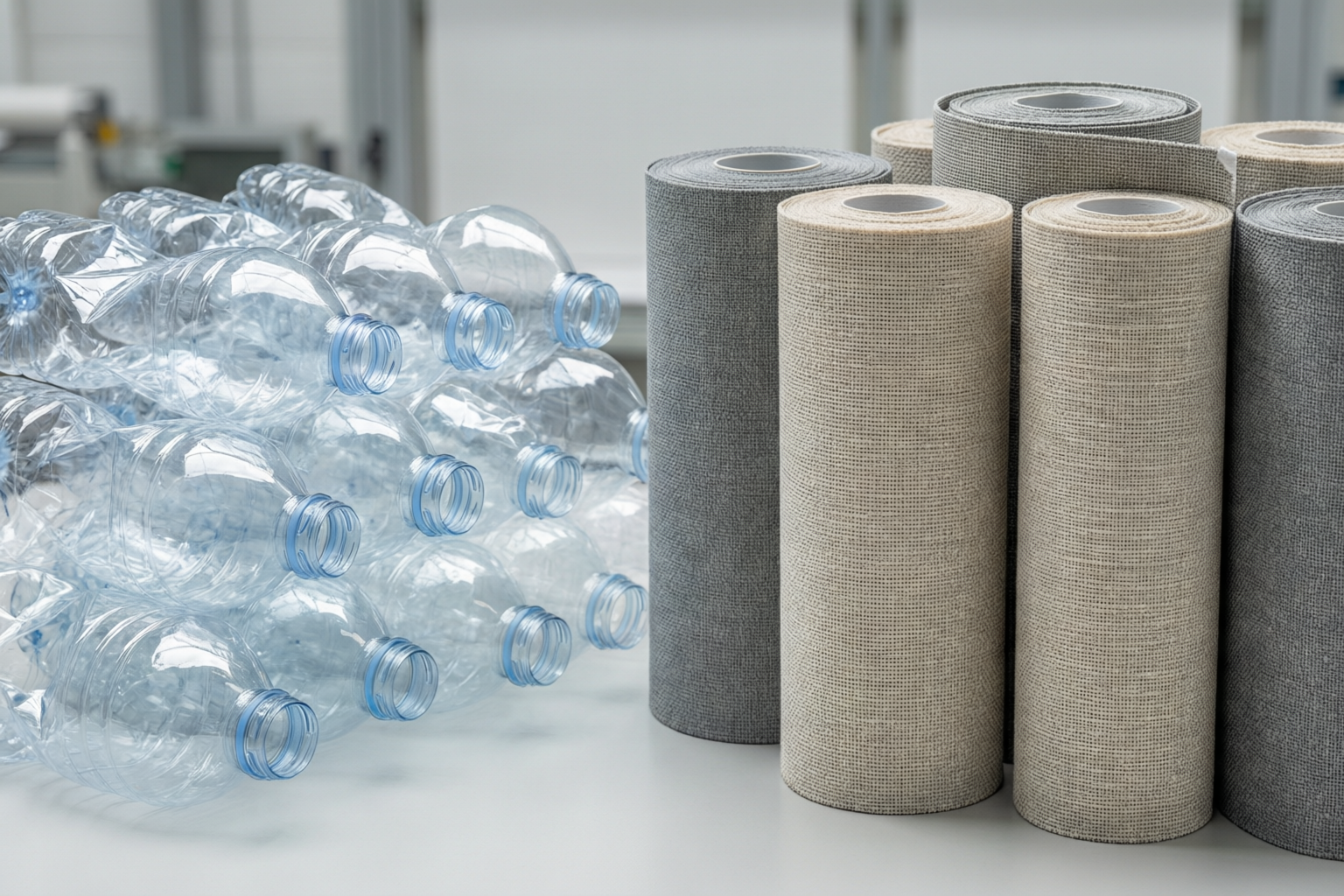
Watch how recycled PET bottles are transformed into polyester fabric.
Recycled PET (rPET) fabric is manufactured from post-consumer plastic waste — primarily beverage bottles and food packaging — that has been collected, cleaned, shredded, and re-extruded into polyester yarn. The process diverts plastic from landfills and oceans while requiring approximately 59% less energy than virgin polyester production, according to a study published in the Journal of Cleaner Production.
The rPET manufacturing process:
- Collection & sorting: Post-consumer PET bottles are collected through municipal recycling programs and sorted by color and polymer type.
- Cleaning & shredding: Bottles are washed, labels removed, and material shredded into clean flakes.
- Pelletization: Flakes are melted and extruded into uniform pellets suitable for fiber spinning.
- Yarn extrusion: rPET pellets are melt-spun into high-tenacity filament yarns, often drawn and textured for optimal weaving performance.
- Weaving & finishing: Yarns are woven on air-jet or rapier looms, then coated, heat-set, and finished to specification.
Environmental impact per square meter of rPET fabric vs. virgin polyester:
- CO₂ emissions reduced by approximately 32%
- Energy consumption reduced by approximately 59%
- Water usage reduced by approximately 20%
- Approximately 8–12 PET bottles diverted from landfill per square meter of fabric
AWT’s RP rPET Recycled series uses certified recycled polyester yarns, providing specifiers with full traceability from post-consumer waste to finished roller blind fabric. Each square meter of RP series fabric represents approximately 10 recycled bottles given new life.
Certifications and Standards for Sustainable Fabrics
When specifying sustainable roller blind fabrics, buyers should look for independent third-party certifications that validate environmental claims:
Global Recycled Standard (GRS): Administered by Textile Exchange, GRS verifies recycled content claims and ensures responsible social, environmental, and chemical practices throughout the supply chain. A GRS-certified fabric guarantees the stated percentage of recycled material.
OEKO-TEX Standard 100: Tests for harmful substances in textiles, including heavy metals, formaldehyde, phthalates, and pesticides. Fabrics certified to OEKO-TEX Standard 100 Product Class II are safe for use in environments where prolonged skin contact is expected.
GREENGUARD / UL ECOLOGO: Certifies low chemical emissions from products used in indoor environments. Particularly relevant for hospitality and healthcare specifications where indoor air quality directly impacts occupant health and comfort.
Cradle to Cradle Certified: Assesses materials across five categories: material health, product circularity, clean air and climate protection, water and soil stewardship, and social fairness. Increasingly specified in Class A commercial projects.
REACH compliance: EU regulation restricting chemicals of very high concern (SVHC). Essential for projects in European markets and increasingly adopted globally as a best practice standard.
AWT Textile’s sustainable fabric lines carry relevant certifications — visit the Certifications & Test Reports page for full documentation.
Contributing to LEED and WELL Building Credits
Sustainable roller blind fabrics can contribute to multiple credits within green building rating systems:
LEED v4.1 credits:
- Materials & Resources (MR) — Building Product Disclosure and Optimization: rPET fabrics with Environmental Product Declarations (EPDs) contribute to Option 1. Fabrics with recycled content documentation contribute to Option 2 (Leadership Extraction Practices).
- Indoor Environmental Quality (EQ) — Low-Emitting Materials: PVC-free fabrics with low VOC emission testing contribute to EQ credit compliance.
- Innovation: Projects achieving exceptional sustainability thresholds may qualify for Innovation credits through exemplary performance in material selection.
WELL Building Standard:
- Air concept: PVC-free fabrics eliminate off-gassing concerns associated with phthalate plasticizers, supporting WELL Air feature compliance.
- Materials concept: Fabrics with Declare labels, HPDs (Health Product Declarations), or Cradle to Cradle certification contribute to WELL Materials optimization features.
For LEED-certified hospitality projects — where roller blinds cover thousands of square meters across guest rooms, lobbies, and conference facilities — the cumulative impact of specifying sustainable fabrics is substantial.
Performance Comparison: Sustainable vs. Traditional Fabrics
A common misconception is that eco-friendly fabrics compromise on performance. Modern PVC-free and rPET fabrics have closed the performance gap with traditional PVC options across all critical metrics:
Light control: PVC-free blackout fabrics achieve 100% light blockage through multi-layer acrylic foam coatings, matching PVC blackout performance. Dim-out options filter 90–95% of visible light. For detailed guidance, see our Blackout vs. Dim-out comparison guide.
Flame resistance: PVC-free fabrics achieve NFPA 701, M1, and B1 fire ratings through inherently flame-retardant polyester yarns and non-halogenated finish treatments. Learn more in our Fire Retardant Standards Guide.
Dimensional stability: High-tenacity polyester construction provides excellent resistance to stretching and sagging, even in large-format roller blinds exceeding 3 meters in width.
UV resistance: Solution-dyed rPET yarns offer superior color fastness (typically 7–8 on the Blue Wool Scale) compared to piece-dyed alternatives, ensuring long-term appearance retention in sun-exposed applications.
Durability: Both PVC-free and rPET fabrics typically achieve 10,000+ Martindale abrasion cycles, suitable for high-traffic commercial environments.
Cost Analysis: Total Cost of Ownership
While PVC-free and rPET fabrics may carry a 5–15% premium over conventional PVC options at the fabric level, the total cost of ownership often favors sustainable alternatives:
Reduced disposal costs: PVC waste requires specialized handling and disposal procedures in many jurisdictions, adding 20–40% to end-of-life costs. PVC-free and rPET fabrics can be recycled through standard polyester streams.
Green building incentives: Projects achieving LEED or WELL certification qualify for tax incentives, expedited permitting, and premium rental rates in many markets. The incremental fabric cost is negligible compared to certification benefits.
Brand value: Hotel chains and commercial developers increasingly market their sustainability credentials. Specifying documented sustainable materials supports brand positioning and guest acquisition.
Regulatory compliance: The EU, California, and several other jurisdictions have enacted or proposed restrictions on PVC in building products. Early adoption of PVC-free alternatives future-proofs specifications against regulatory risk.
Applications in Hospitality and Commercial Spaces
Sustainable roller blind fabrics are suitable for virtually every commercial application:
Hotel guest rooms: PVC-free blackout fabrics provide the 100% light blockage guests expect while eliminating VOC off-gassing in enclosed rooms. Several international hotel chains have adopted PVC-free specifications as part of corporate sustainability programs.
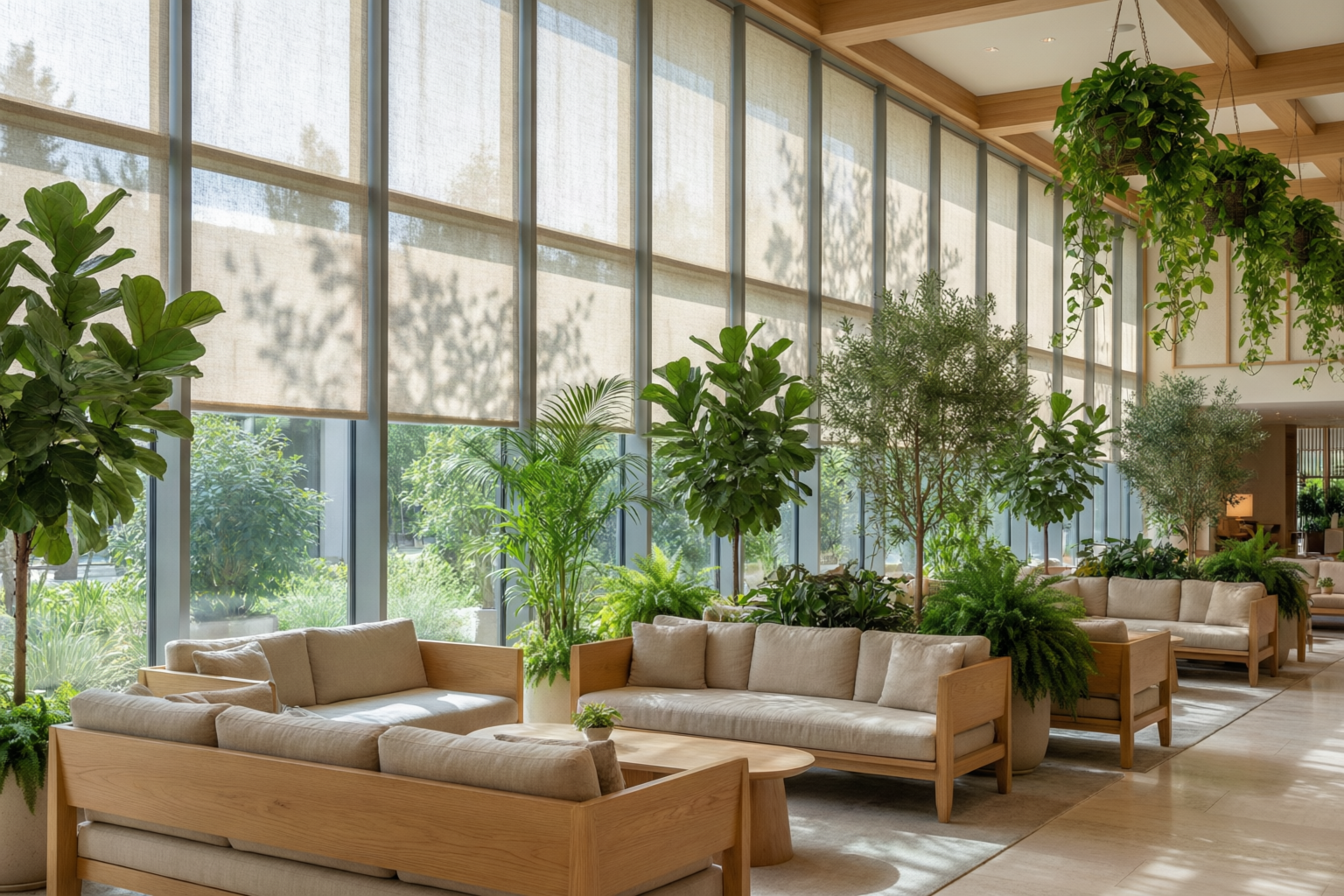
Lobbies and public areas: rPET sunscreen fabrics manage solar heat gain and glare in glass-walled atriums while supporting the building’s sustainability narrative — a point of differentiation for eco-conscious guests.
Conference facilities: Dim-out fabrics with rPET content provide the light control needed for AV presentations while meeting the low-emission requirements of modern office standards.
Healthcare environments: PVC-free fabrics eliminate phthalate exposure concerns in patient rooms, particularly in neonatal and pediatric wards where vulnerable populations require the highest indoor air quality standards.
Education facilities: Schools and universities pursuing CHPS (Collaborative for High Performance Schools) or similar standards benefit from PVC-free, low-emitting window treatments.
AWT Textile’s Sustainable Fabric Range
AWT Textile offers two dedicated sustainable fabric series, complemented by eco-conscious options across the broader catalog:
PF PVC-Free Eco Series: 100% PVC-free roller blind fabrics available in blackout, dim-out, and light-filtering constructions. Achieves NFPA 701 and OEKO-TEX certification. Suitable for hospitality, healthcare, and education specifications where PVC elimination is required.
RP rPET Recycled Series: Certified recycled polyester fabrics with full supply chain traceability. Available in multiple weights and opacities. Each square meter diverts approximately 10 PET bottles from landfill.
Both series are available in AWT’s full color range and can be sampled through our free color card program. For guidance on selecting the right sustainable fabric for your project, see our comprehensive Buyer’s Guide.
The Future of Sustainable Window Treatment Materials
The sustainable fabric market continues to evolve rapidly. Key trends shaping the next generation of roller blind fabrics include:
Bio-based polymers: Research into PLA (polylactic acid) and bio-based polyesters derived from sugarcane or corn starch promises fabrics with reduced fossil fuel dependency. While not yet available at commercial scale for roller blinds, pilot production lines are operational.
Chemical recycling: Unlike mechanical recycling (which downcycles material quality), chemical recycling breaks polyester back to its monomer components, enabling true closed-loop recycling. Several major fiber producers have announced commercial-scale chemical recycling facilities.
Digital product passports: The EU’s Strategy for Sustainable and Circular Textiles proposes mandatory digital product passports providing full material composition, recycling instructions, and supply chain transparency. Forward-thinking manufacturers are already preparing compliance infrastructure.
Carbon-negative fabrics: Emerging technologies capture CO₂ during polyester production, potentially creating fabrics with net-negative carbon footprints. While still in development, these innovations signal the industry’s direction.
Making the Switch: A Practical Checklist
For specifiers ready to transition to sustainable roller blind fabrics, follow this practical checklist:
- Audit current specifications: Identify where PVC fabrics are currently specified and prioritize replacement based on volume and occupant sensitivity (healthcare and education first).
- Request samples: Contact AWT Textile for free samples of PF and RP series fabrics to evaluate hand-feel, color accuracy, and light control performance.
- Verify certifications: Request test reports and certification documents to include in project submittals.
- Update specification documents: Replace generic PVC references with performance-based specifications that PVC-free and rPET fabrics can meet.
- Document sustainability contributions: Work with manufacturers to obtain EPDs, HPDs, and recycled content letters needed for green building certification submissions.
- Plan end-of-life: Establish take-back or recycling agreements for fabric replaced during renovations, closing the circularity loop.
Related Resources
Continue your research with these guides from AWT Textile:
- OEKO-TEX vs GRS vs GREENGUARD: Sustainable Fabric Certifications Explained — which certification proves safety, recycled content or low emissions
- How to Choose Roller Blind Fabric: A Buyer’s Guide — the five key factors every B2B buyer should evaluate
- Blackout vs. Dim-out Fabric: Hotel & Hospitality Expert Guide — detailed comparison for hospitality specifications
- NFPA 701 vs. M1 vs. B1: Fire Retardant Standards Guide — understand fire safety requirements for your market
- Roller Blind Fabric Glossary — technical terminology explained for B2B buyers
- Browse all AWT fabric series — explore the full range of 9 series and 160+ SKUs
Related guides & fabrics
- OEKO-TEX vs GRS vs GREENGUARD Explained — which certifications to specify alongside PVC-free compositions
- Fabric Certifications Overview — test reports and compliance documents
Sourcing certified eco fabrics?
Share your specification or sustainability targets — we’ll confirm certifications and ship free PVC-free samples with a project quote within 24 hours.
FAQ: PVC-Free Blind Fabrics for Commercial Spaces
What is PVC-free roller blind fabric?
PVC-free blind fabric replaces polyvinyl chloride with polyolefin or recycled polyester faces, so it contains no chlorinated vinyl or phthalate plasticisers. It behaves like conventional roller fabric on standard hardware while meeting low-VOC and recyclability specifications.
Are PVC-free blind fabrics suitable for offices and commercial spaces?
Yes. They are specified for offices, hotels and healthcare projects because they combine low VOC emissions, recyclable content (GRS) and fire-retardant finishes. Verify the FR standard (e.g. NFPA 701 or B1) per project before ordering.
How do I verify a blind fabric is genuinely sustainable?
Ask for GRS or RCS scope certificates for recycled content, OEKO-TEX STANDARD 100 for substance safety, and the supplier’s recyclability statement. Certificates should name the exact fabric series, not just the company.
Related Guides
OEKO-TEX, GRS & GREENGUARD certification guide | Sunscreen fabric guide for commercial spaces | Browse PVC-free fabric SKUs | Request free samples
Explore the fabric series
- OD Outdoor Shade Fabric series — full specs, pricing & fire ratings
- ME Middle East series — full specs, pricing & fire ratings
- JH Jacquard / Printed series — full specs, pricing & fire ratings
- MT Motorized-Ready series — full specs, pricing & fire ratings
- RP rPET Recycled series — full specs, pricing & fire ratings
- PF PVC-Free Eco series — full specs, pricing & fire ratings
- GR Light Filtering series — full specs, pricing & fire ratings
- ZB Zebra / Day & Night series — full specs, pricing & fire ratings
- JR Screen / Sunscreen series — full specs, pricing & fire ratings
- BR Blackout Series series — full specs, pricing & fire ratings